
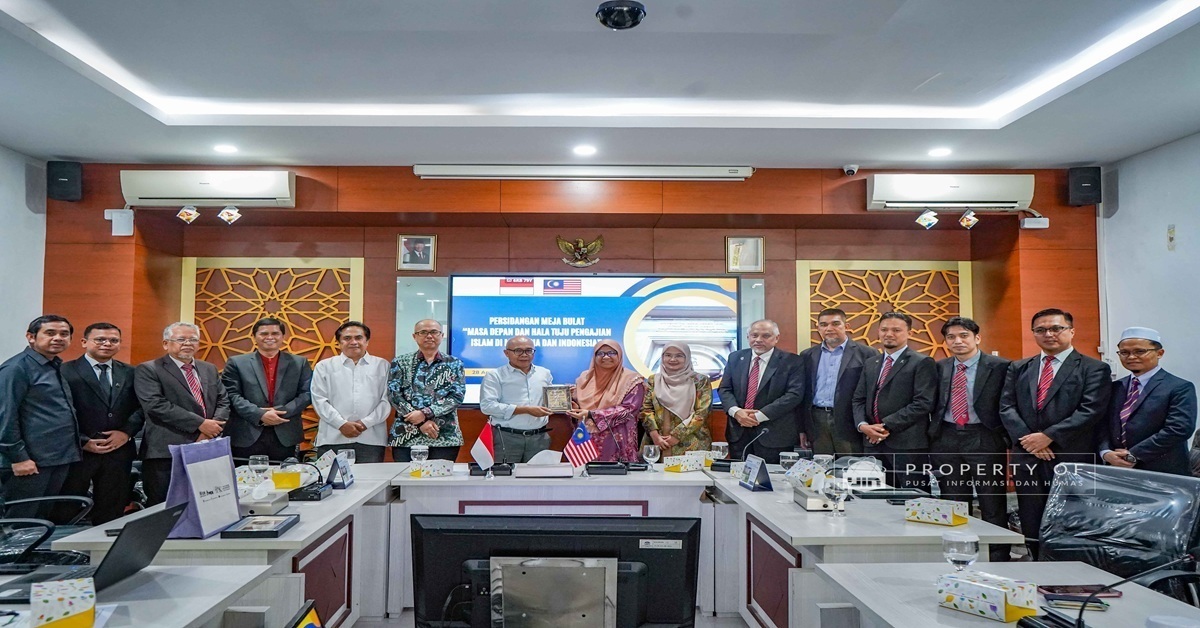
Indonesia-Malaysia Synergy: UIN Jakarta and MDPI Discuss Future of Globally Impactful Islamic Studies
JAKARTA — Syarif Hidayatullah State Islamic University (UIN) Jakarta held a strategic meeting with the Council of Deans of Islamic Studies (MDPI) Malaysia to discuss the future of Islamic studies with global impact. The collaboration focuses on strengthening interdisciplinary research, student and lecturer exchanges, and utilizing digital technology to address modern-day challenges.
The event brought together academic leaders from both countries, including the Dean of the Academy of Islamic Studies at Universiti Malaya (UM), Prof. Dr. Mohd. Fauzi Bin Hamat; Prof. Dr. Selamah (Universiti Utara Malaysia/UUM); Prof. Dr. Hasan bin Ahmad (Center for Human Sciences); Prof. Dr. Abdulkarim (UM); Prof. Dr. Kamarusdiana, M.H. (UIN Jakarta); as well as representatives from the Faculty of Ushuluddin at UIN Jakarta.
In his remarks, Prof. Dr. Mohd. Fauzi Bin Hamat highlighted Universiti Malaya's achievement in ranking 40th globally in religious studies. To enhance graduate quality, UM offers various innovative programs, including a thesis competition for final-year students with full master's degree scholarships at UM for the top seven participants, along with community service programs focused on local problem-solving.
Meanwhile, Prof. Dr. Selamah from UUM encouraged renewing the Memorandum of Understanding (MoU) with UIN Jakarta, which expired in 2012. She emphasized the importance of strengthening dual degree programs, matching grants, joint publications, and student mobility. Echoing this sentiment, Prof. Dr. Hasan bin Ahmad also proposed expanding cooperation in joint supervision and research matching grants.
Explaining the trajectory and transformation of Sharia studies in Malaysia, Prof. Dr. Abdulkarim outlined the evolution of Islamic education, starting from the traditional pondok system based on classical texts (turath), developing into formal madrasahs, and maturing into academic disciplines in higher education.
"Currently, Sharia Studies are undergoing modern transformation through Outcome-Based Education (OBE), e-learning, and Open Distance Learning (ODL)," explained Prof. Abdulkarim.
He added that future efforts will focus on integrating Maqasid al-Shariah with contemporary issues such as the Halal Industry, Islamic Fintech, Waqf, Environmental, Social, and Governance (ESG) principles, and Artificial Intelligence (AI). To preserve sincerity and academic integrity amid condensed study periods (3 years for undergraduate degrees), standard curriculum enhancements are combined with the traditional talaqqi learning method. On the Indonesian side, Prof. Dr. Kamarusdiana, M.H. detailed the landscape of Islamic legal studies at UIN Jakarta and its application within the national legal system. Islamic law in Indonesia is formally integrated into family law, Islamic banking and economics, and religious courts operating under the Supreme Court.
"Sharia and Law graduates in Indonesia enjoy broad and strategic career prospects, ranging from judges in Religious Courts, general court judges, prosecutors, advocates, to legal officers," noted Prof. Kamarusdiana while explaining the national judicial flowchart.
Ushuluddin UIN Jakarta: International Reputation and Epistemic Leadership
The Faculty of Ushuluddin at UIN Jakarta presented its strategic achievements as the 'epistemic core' of Islamic studies in Indonesia. Having achieved "Unggul" (Superior) accreditation from BAN-PT, international accreditation from ACQUIN for five study programs in 2025, and placing 29th globally for Theology, Divinity & Religious Studies in the 2026 QS World University Rankings, UIN Jakarta is positioned to lead global Islamic studies.
To navigate the challenges of the digital era, the Faculty of Ushuluddin promotes three main frameworks: Epistemic Authority, utilizing classical disciplines as dynamic methodological tools; Public Reason and Ethics, addressing pluralism and public policy; and Lived Religion, leveraging digital humanities to analyze religious discourse on social media and shield society from AI-driven misinformation.
The meeting between UIN Jakarta and MDPI Malaysia concluded with agreements to establish joint research clusters, co-supervision programs for master's and doctoral students, teaching residencies for faculty, and collaborative publications in high-reputation journals.
This synergy is expected to foster a Southeast Asian Islamic studies tradition that is methodologically sound, ethically grounded, digitally competent, and capable of creating a tangible impact on global social welfare. (fianaS/IO)